Css Prep
Contents
1.CSS
CSS Cascading Style Sheets (Cascading Style Sheets) is a computer language used to express document styles such as HTML (an application of Standard Generalized Markup Language) or XML (a subset of Standard Generalized Markup Language).
Because CSS does not have its own programming syntax such as variables, constants, conditional statements, functions, etc. as ordinary programming languages, but only simple attribute descriptions line by line, it is quite troublesome to write, and the code is difficult to organize and maintain.
2.DRY
DRY, or Don’t Repeat Yourself, is a programming philosophy familiar to programmers, and good programmers usually write code following this specification.
DRY can significantly improve the maintainability of the code. For example, when a parameter needs to be changed, only one or a few places need to be changed.
3.CSS preprocessor
Pure CSS code does not have concepts such as variables, nesting, conditions, etc., and it is difficult to achieve DRY, which causes programmers a headache. Therefore, some programmers try to add some programming features to CSS, making it possible to use variables, simple program logic, and functions in CSS.
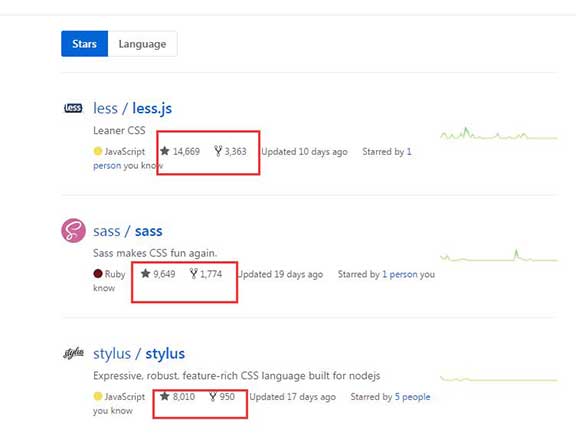
Currently, there are three most commonly used CSS preprocessors: Less, SASS, and Stylus.
It can be seen from GitHub that Less is the most popular CSS preprocessor.
3.Less
3.1 Installation
Because Less is written in JavaScript language, it can run in the NodeJS environment on the server side. Therefore, the simplest installation method is to use npm install.
npm install -g less # -g means global installation
3.2 Compilation
The suffix of Less files is .less. Browsers cannot directly recognize .less files and need to be compiled into CSS style files ending in .css.
Assuming you already have a less file demo.less, execute the following command on the command line to compile and generate demo.css.
lessc demo.less demo.css
lessc is the command of Less. The first parameter demo.less specifies the name of the source file that needs to be compiled. The second parameter demo.css is the name of the compiled CSS file.
If you need to compile it into a compressed CSS file, you can install and download a plug-in officially provided by Less globally clean-css plugin.
npm install -g less-plugin-clean-css
Then, enter the following command on the command line:
lessc –clean-css demo.less demo.min.css #One more parameter –clean-css
3.3 Basic syntax
3.3.1 Variables
Less variable names start with the @ symbol, for example:
@nice-blue: #5B83AD; @light-blue: @nice-blue + #111;
#header { color: @light-blue; }
After compilation, you get the following code:
#header { color: #6c94be; }
Note: Less variables are essentially constants and can only be defined once.
3.3.2 Mixins
A way to introduce (“mix”) a series of properties from one ruleset into another.
For example, first define a rule
.bordered { border-top: dotted 1px black; border-bottom: solid 2px black; }
If you want to use this rule elsewhere, you can do this:
#menu a { color: #111; .bordered; }
.post a { color: red; .bordered; }
The compilation results are as follows:
.bordered { border-top: dotted 1px black; border-bottom: solid 2px black; } #menu a { color: #111; border-top: dotted 1px black; border-bottom: solid 2px black; } .post a { color: red; border-top: dotted 1px black; border-bottom: solid 2px black; }
3.3.3 Nesting
Nest style rules according to HTML structure.
#header { color: black; .navigation { font-size: 12px; } .logo { width: 300px; } }
Compiled CSS style file:
#header { color: black; } #header .navigation { font-size: 12px; } #header .logo { width: 300px; }
You can also combine pseudo-classes for nesting. For example, the “clear float” style can be written like this:
.clearfix { display: block; zoom: 1;
&:after { content: " “; display: block; font-size: 0; height: 0; clear: both; visibility: hidden; } }
The symbol & in the above code represents the parent selector of the current selector.
The result after compilation is as follows:
.clearfix { display: block; zoom: 1; } .clearfix:after { content: " “; display: block; font-size: 0; height: 0; clear: both; visibility: hidden; }
3.3.4 Media queries and nesting
Media query (Media query) can be nested in the selector. When compiling, the selector will be automatically copied into the media query body. Media queries can also be nested in media query rules.
.screen-color { @media screen { color: green; @media (min-width: 768px) { color: red; } } @mediatv{ color: black; } }
Compilation result:
@media screen { .screen-color { color: green; } } @media screen and (min-width: 768px) { .screen-color { color: red; } } @mediatv{ .screen-color { color: black; } }
3.3.5 Operation
In Less, numerical values, colors, and variables can be added, subtracted, multiplied, and divided.
@color: #224488 / 2; //results in #112244 background-color: #112244 + #111; // result is #223355
@base: 5%; @filler: @base * 2; // result is 10% @other: @base + @filler; // result is 15%
3.3.6 Function
Less provides a number of functions for converting colors, manipulating strings, and performing arithmetic operations. For details, please refer to Less Function Reference
These functions are very simple to use.
@base: #f04615; @width: 0.5;
.class { width: percentage(@width); color: saturate(@base, 5%); background-color: spin(lighten(@base, 25%), 8); }
In the above code, we use the function percentage() to convert 0.5 to 50%, then use the function saturate() to increase the saturation of the base color value by 5%, then use the function lighten() to increase the brightness of the background color by 25%, and finally use the function spin() to increase the hue value by 8. After compilation:
.class { width: 50%; color: #f6430f; background-color: #f8b38d; }
3.5 official website
For more content, you can visit http://lesscss.org/